
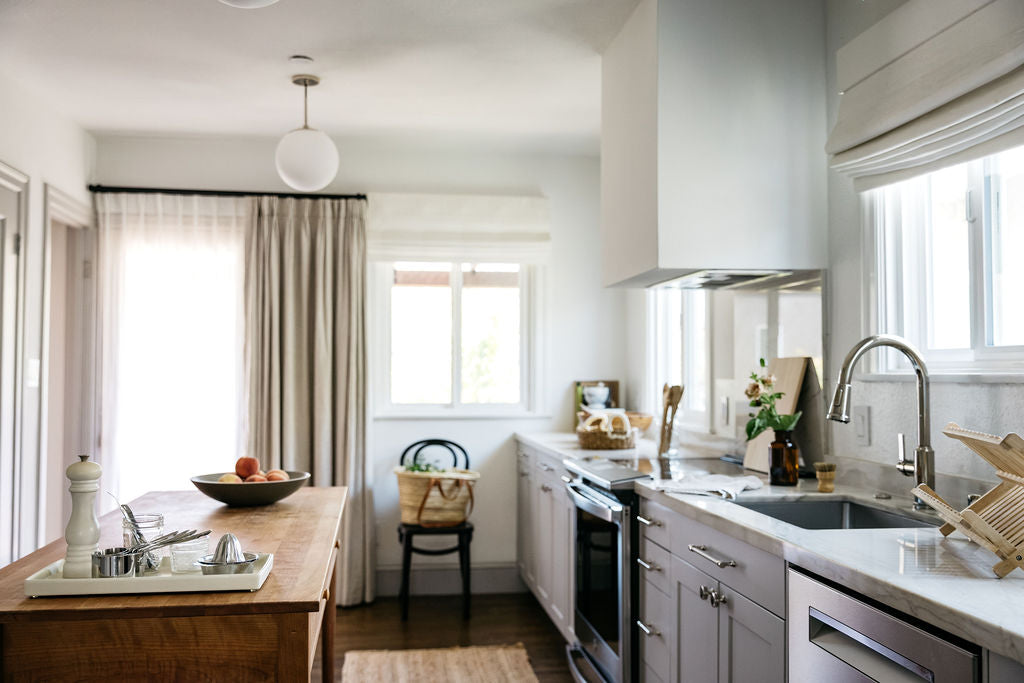
The air inside a family home is more polluted than the air outside — and most of it comes from materials already in the house. Here's the healthy home materials and cleaning framework, room by room.
By Jackie | Interior Designer | A Design Lifestyle
As Seen In ARCHITECTURAL DIGEST & FORBES
What's actually in your home right now?
The air inside a family home is more polluted than the air outside. Not occasionally — consistently. And most of it comes from the materials, finishes, and products already inside the house.
Volatile organic compounds in paint. Off-gassing from synthetic carpets and new furniture. Formaldehyde in MDF cabinetry. Synthetic fragrance in cleaning products. Plasticizers in vinyl flooring.
Most families don't discover this until a child has recurring respiratory issues, or a new piece of furniture smells chemical for months after delivery, or a renovation leaves the house feeling wrong in a way that's hard to name.
Healthy home design is the preventive approach. It starts before the purchase — with the materials you choose, the finishes you specify, and the habits you build into the home's maintenance.
This is not expensive. It is intentional.
The healthy home materials framework.
Every surface in a family home that is touched, breathed near, or lived on daily deserves to be evaluated through a non-toxic lens. Here is the framework — room by room, material by material.
Paint. Zero-VOC paint is the most accessible healthy-home upgrade available to any family. VOCs — volatile organic compounds — are the chemicals that give fresh paint its smell. They off-gas for weeks to months after application, affecting air quality in enclosed spaces. Zero-VOC paint is available at every major paint retailer. It costs the same as standard paint. There is no reason to use anything else in a family home.
Flooring. Hardwood, natural stone, ceramic tile, and natural cork are the healthy home flooring standards. They do not off-gas, they can be properly cleaned, and they last for decades.
Luxury vinyl plank flooring, one of the most-sold flooring choices, contains phthalates and other plasticizers that off-gas over time. In a family home where children sit and play on the floor, flooring material matters.
Cabinetry. Standard MDF and particleboard cabinetry contain formaldehyde in the binding agents. Solid wood cabinetry does not. When specifying cabinetry for any room — kitchen, bathroom, laundry, closets — look for CARB2-compliant products at a minimum and solid-wood construction where budget allows.
Rugs. Wool, jute, sisal, and seagrass are the healthy home rug standards. Synthetic rugs — nylon, polyester, polypropylene — off-gas and hold allergens in ways that natural fiber rugs do not. A wool rug costs more upfront and lasts three times longer. It is the better investment.
Upholstery. Natural fiber upholstery — linen, cotton, wool, leather — does not off-gas and can be properly cleaned. Synthetic upholstery fabrics treated with stain repellents often contain PFAS — the same "forever chemicals" found in non-stick cookware. Look for OEKO-TEX-certified fabrics when natural fibers aren't possible.

The air in your home.
Materials are the foundation of healthy home design. Air quality is the daily practice.
Ventilate every room. The most immediate and affordable thing any family can do to improve indoor air quality is to open windows. A little cross-ventilation every morning — two windows on opposite sides of the home — replaces stale indoor air with fresh outdoor air. Do this daily.
Run the range hood every time you cook. Cooking generates CO2, particulate matter, and moisture. A properly vented range hood removes all three. It is one of the most overlooked healthy home interventions in residential design. Non-negotiable in a family kitchen.
Replace synthetic fragrance with natural alternatives. Synthetic air fresheners, plug-in diffusers, and scented candles made with paraffin wax and synthetic fragrance are among the most significant sources of indoor air pollution in a family home. Replace with:
- Essential oil diffusers — a few drops of lavender, eucalyptus, or peppermint in water
- Fresh flowers — lavender, mint, and jasmine all purify air naturally while adding fragrance
- A reed diffuser with a natural oil base — flame-free, ambient fragrance
- Open windows — the original air freshener
Add plants intentionally. Pothos, snake plants, peace lilies, and spider plants all remove toxins from indoor air. One plant per 100 square feet is a practical starting point. They require minimal maintenance and improve both air quality and well-being.
The School Morning Reset: the entryway plan I install for clients. At your own pace. I got you. Send Me the Reset →
The healthy home cleaning framework.
The products used to clean a family home are as important as the materials it is built with. Most conventional cleaning products contain synthetic fragrance, harsh solvents, and endocrine-disrupting chemicals.
The healthy home cleaning standard:
Surfaces: Diluted Castile soap effectively cleans 90% of household surfaces. Add white vinegar for streak-free glass. Add hydrogen peroxide for disinfection when needed.
Floors: Steam cleaning on hard floors — no chemical products required. A damp microfiber mop on sealed wood and stone.
Laundry: Fragrance-free, plant-based detergent. No dryer sheets — wool dryer balls instead. Synthetic fragrance in laundry products is one of the most common hidden sources of chemical exposure in a family home.
Air: No synthetic air fresheners anywhere in the home. Ever.
The cleaning products in a family home affect the air the family breathes every day. Choose accordingly.

Where to start.
Healthy home design does not require a renovation. It requires intention — applied consistently, starting with the next purchase, the next product, the next material decision.
The healthy home hierarchy:
First — stop bringing toxins in. Replace synthetic fragrance. Switch to zero-VOC paint on the next repaint. Choose natural fiber rugs for the next replacement.
Second — improve air quality now. Open windows daily. Run the range hood every time you cook. Add three plants.
Third — apply the non-toxic lens to every future material decision. Flooring. Cabinetry. Upholstery. Each time a replacement or renovation comes up, choose the healthier option.
The healthy home is not built in a day. It is built decision by decision, over the life of the home.
"With two young children, sustainability is important to us. She introduced us to materials that are environmentally friendly and nontoxic. Our home feels like us." — C.N.
The non-toxic lens is woven throughout every toolkit.
Most design resources treat healthy home choices as a bonus section — a checklist at the back, an afterthought.
In every toolkit, the non-toxic lens is woven throughout — the materials guides, the room-by-room checklists, the renovation guides, the cleaning schedules. Because a healthy home is not a separate category. It is a standard applied to every decision.
Every room. Every material. Every life stage.
Furnishing? The non-toxic lens runs through every room guide in The Furnishing Standard Toolkit.
Renovating? Every material spec in The Renovation Standard Toolkit is filtered through it first.
Not ready to buy anything yet? Start free with The School Morning Reset.
Step-by-step interior design fillable workbooks and interactive project manager spreadsheets, built for family homes — from first home to forever home.
Or explore the toolkits: Shop the tools →

About Jacqueline Norrise
As Seen In ARCHITECTURAL DIGEST & FORBES
Jacqueline Norrise is an Architectural Digest–featured interior designer with a BFA in Interior Architecture & Design from the Academy of Art University in San Francisco, 15+ years of projects, and 100+ family homes, from the San Francisco Bay Area to New York, Los Angeles, Colorado, Seattle, and more. After years of full-service design work, she built her entire Method — the questionnaires, room-by-room guides, budget planning, materials education, and maintenance routines she used with every client — into the Family-Proof Method.
Step-by-step interior design fillable workbooks and interactive project manager spreadsheets, built for family homes — from first home to forever home.
Follow along on Pinterest — #homerefreshclub #adesignlifestyle


